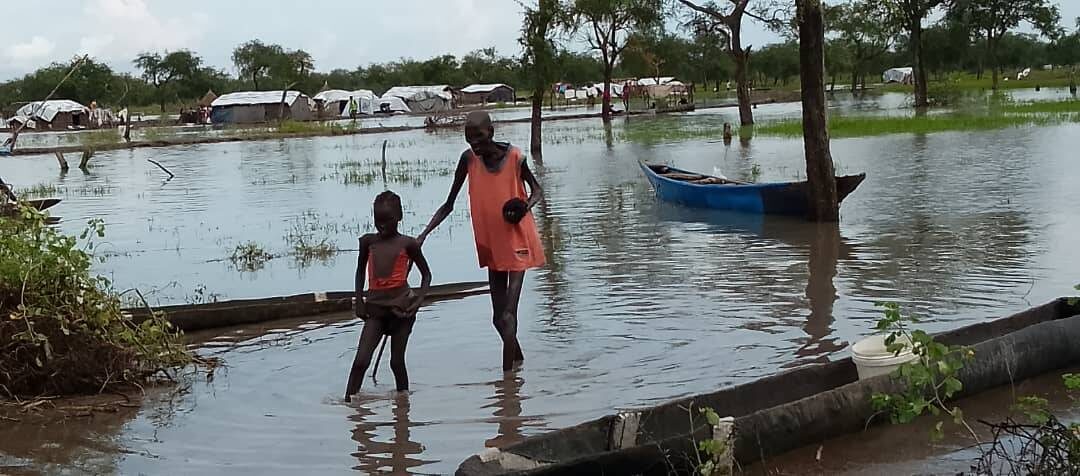
JUBA – At least 19 people have died as 639,225 were affected by devastating floods triggered by heavy rainfall and rising River Nile water levels across six states in South Sudan as of October 2025, the United Nations humanitarian agency said.
Jonglei and Unity account for over 88 per cent of the affected populations, according to UN Office for Coordination of Humanitarian Affairs (UN OCHA).
It indicates that communities have lost farmland, livelihoods, homes, and access to essential services, including schools and health facilities, with at least 121 health facilities have been impacted. Reports include 19 flood-related deaths.
“As of 1 October, an estimated 639,225 people have been affected by flooding across 26 counties in six states, with Jonglei and Unity accounting for over 88 per cent of the caseload,” it stated.
Out of the affected populations, an estimated 380,277 are in Jonglei State, about 179,991 people are in Unity State, some 29,374 are in Upper Nile State, about 24, 505 are in Central Equatoria State and 10,578 people are in Warrap State.
Nearly 175,000 people are displaced and sheltering on higher ground in 16 counties.
OCHA says humanitarian partners are delivering life-saving aid, though access remains difficult due to impassable roads, especially in Unity, Upper Nile, and Jonglei States.
The agency said there were 19 flood-related deaths in Jonglei, Unity and Northern Bahr el Ghazal between August and September, 144 snake bites, and 3,391 malnutrition cases across 11 counties.
It adds that health concerns are escalating, with rising cases of malaria, respiratory infections, and diarrhea.
Upper Nile State
Authorities report over 10,000 people affected by flooding in Waidisa Payam, Maiwut County. In Malakal County, an estimated 5,800 individuals (964 households) were impacted in Pamath, Wau Ogod, Padiet, and Pathaw. In Fashoda County, approximately 737 people have been affected in Lul Payam.
An inter-agency rapid needs assessment confirmed that at least 14,600 individuals (2,000 households) were affected by floods in Mathiang, Palam, and Malual Payams in Longochuk County. Flooding also threatens Renk Transit Center, with surrounding areas submerged and unofficial crossing points from Sudan to Renk town now inaccessible due to flooding.
Unity State
Widespread flooding continues to affect Leer, Mayendit, Panyijiar, and Koch, displacing communities and increasing protection risks especially for children. In Bentiu and Rubkona towns, hundreds of thousands of people remain below the waterline, protected only by earthen dykes that require constant monitoring and reinforcement to prevent further flooding.
The International Organization for Migration (IOM) continues to monitor water levels and has launched an online dashboard to support flood response and information sharing.
In Panyijiar County, homes, markets, schools, and health facilities remain submerged. Youth-led efforts to repair dykes have partially restored access to the Ganyiel airstrip, allowing limited humanitarian deliveries.
In Mayendit County, flooding has forced the closure of 18 schools, disrupting learning for 6,037 children (including 3,143 girls). Four health facilities have been relocated due to rising water levels and continue to operate under challenging conditions. Several others are at high risk of flooding.
An NGO reported the displacement of over 1,700 people (286 households) across Dablual, Buor, Kok, Mirnyal, and Thaker. Mayendit South remains particularly vulnerable due to its low-lying terrain and poor drainage. Access challenges and service disruptions are intensifying, with ongoing rainfall expected to worsen conditions.
As of 2 October, humanitarian partners report rapidly deteriorating road conditions across Unity State following heavy rains since 29 September. Roads connecting Bentiu Town are severely damaged and at risk of flooding.
Most southern counties are now inaccessible by road, with access limited to canoe transport. Humanitarian actors are relying on canoes to deliver essential supplies. Persistent flooding and collapsing infrastructure continue to restrict access and disrupt the delivery of humanitarian assistance.
Jonglei State/the Greater Pibor Administrative Area
In Fangak County, an inter-agency rapid needs assessment conducted on 1 October in Kuernyang/Barbuoi Payam found the entire area submerged following heavy rains on 30 September.
The flooding has affected an estimated 44,000 people, including those previously displaced by conflict in New Fangak. Many have relocated to higher ground in nearby villages, while others remain stranded on isolated islands.
Floodwaters have rendered key infrastructure including the payam office, market, health facility, and humanitarian compounds non-functional, significantly hindering response efforts. Communities are attempting to construct dykes and drain floodwaters but lack sufficient materials and equipment. Priority needs include WASH services, nutrition support, shelter, non-food items, fishing kits, and dyke construction materials.
In the Greater Pibor Administrative Area, local authorities report that more than 50,000 people have been affected by flooding across Pibor, Likuangole, Gumuruk, Verteth, and Pochalla counties. An inter-agency rapid needs assessment has been completed, with verified figures expected in the coming days.
In response, IOM has engaged 30 casual laborers to reinforce dykes in Pibor Town, with plans to increase the workforce to 50 in the coming period.

